A guide for principals and trustees

School Health Services in India

Educure School Health arranges school health services in India: on-campus student health checkups, school clinic and nurse support, counsellor and child psychologist services, student fitness assessment and health awareness sessions. Schools can request one service or a coordinated programme, with clinical scope, professional qualifications, dates and availability confirmed in a written proposal.

For principals and trustees, this page brings together the services you can arrange, the ten components of a school health programme, government policy context and what to compare before appointing a provider. Educure is a private school healthcare provider, separate from government programmes. Services are contracted through schools, not public walk-in clinics.

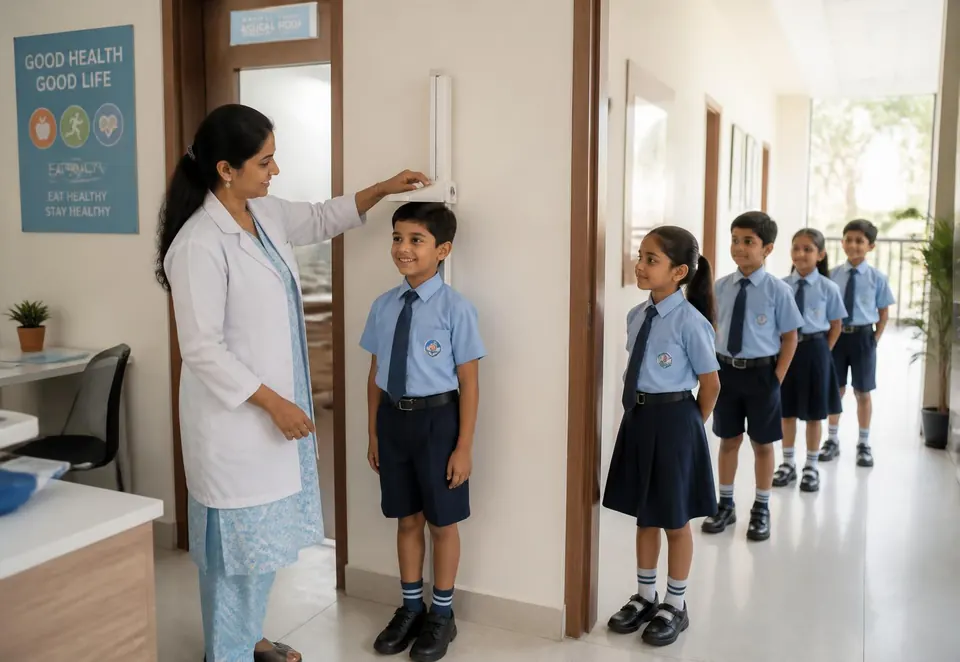
School doctor and students during a school health programme in India
One coordinated school health programme

Scope and staffing confirmed in your proposal

School health services you can arrange with Educure

A school's health needs extend beyond a one-day camp. Match each service to a practical responsibility: screening and family follow-up, care during school hours, emotional support, inclusive movement or health education. The links below explain scope and quotation conditions; no single package automatically includes every service.

For health and first-aid responsibilities, see school safety planning. Building, fire and transport certification belong with the appropriate authorities and professionals.

The components of school health services

A complete school health programme has ten connected parts. Few schools start with all of them; most build up over time.

Objectives of school health services

  • Detect common health problems early, when they are easiest to address
  • Make sure every flagged concern has a clear referral and follow-up
  • Respond safely and quickly to illness, injury and emergencies on campus
  • Build lifelong healthy habits through education and practice
  • Support students' emotional wellbeing and readiness to learn
  • Keep accurate, private health records for each child
  • Keep parents informed and involved in their child's health
  • Give school leaders the information they need to plan and improve

Why school health services matter

Children spend a large part of their day at school, so the school is often where a problem is first noticed: a child who cannot read the board, who is often tired, or whose behaviour changes. Without a system, these signs depend on one alert teacher. With school health services in place, every child is looked at regularly and the next step is clear.

Health and learning are closely connected. A child with an uncorrected vision problem, a toothache or untreated anxiety will struggle in class however good the teaching is. For school leaders, a structured programme also brings practical benefits: safer handling of emergencies, records that support inspections and board requirements, and greater confidence among parents.

Official context: government school health programmes

National Education Policy 2020

Paragraph 2.9 of NEP 2020 says that children's nutrition and health, including mental health, will be addressed in schools, including through counsellors and social workers, and that all school children shall undergo regular health check-ups, especially for 100% immunisation, with health cards issued to monitor them.

Ayushman Bharat School Health and Wellness Programme

A joint initiative of the Ministry of Health and Family Welfare and the Ministry of Education, launched in February 2020 for government and government-aided schools. Two teachers in each school are trained as Health and Wellness Ambassadors and deliver weekly activity-based sessions on 11 thematic areas.

Rashtriya Bal Swasthya Karyakram (RBSK)

A national programme that screens children from birth to 18 years for defects at birth, diseases, deficiencies and developmental delays, and refers identified children for treatment, including through District Early Intervention Centres. Screening in government schools and Anganwadis is done by mobile health teams.

These are government programmes. Educure is a private school healthcare provider; our services are separate from, and do not replace, these programmes. Schools should confirm the current requirements of their board and state.

Sources

How Educure delivers school health services

Educure works with private, aided, CBSE, ICSE, state-board and international schools to plan and run school health services on campus. Most schools start with one service, often the annual student health checkup, and add others such as a school nurse, a counsellor, fitness assessment or awareness sessions as their needs become clear.

Each programme begins with a conversation about enrolment, grades, campus facilities, timetable and existing staff. We then prepare a written proposal setting out the scope, staffing, dates, reporting and price, including GST and any travel. Availability, staff hours and scope are confirmed in the proposal rather than assumed. Consent is collected before screening, every family receives a private report, and school leaders receive an aggregate summary.

This national guide explains the service category and policy context. For Educure's combined delivery model, see our coordinated school health programme.

Services for different kinds of school

Choosing a provider? Read 12 questions to ask a school health service provider.

How to arrange school health services in India

To arrange school health services anywhere in India, start with the actual campus needs rather than a list of promised outcomes. A day school with an existing nurse needs a different plan from a residential campus or a school group coordinating several branches.

  1. 1. Share the campus requirement

    Provide the exact campus location, enrolment, grades, academic timetable, current nurse or counsellor provision and preferred service dates. Include separate details for every branch and any accessibility needs.

  2. 2. Agree scope and responsibilities

    Choose screening modules, clinic or counselling hours, fitness activities and awareness topics. Confirm proposed professional qualifications, private rooms, equipment, supplies, safeguarding duties and emergency referral responsibilities.

  3. 3. Prepare consent and delivery

    Agree informed consent, authorised parent contacts, class-wise movement and secure report access. Document how known care instructions reach responsible clinical staff without sharing a child's records more widely than necessary.

  4. 4. Review reports and follow-up

    Separate completed screening from outstanding referrals. Families receive their child's findings; management uses non-identifying summaries to plan the next session or service. A referral recommendation is not evidence that treatment has been completed.

What to confirm in your school proposal

  • A written scope identifying selected services, proposed staffing, timetable and campus responsibilities
  • A consent and privacy process, with individual records restricted to authorised access
  • Private parent reports and appropriate aggregate school summaries for the agreed screening scope
  • An agreed process for questions, clinical referrals, safeguarding and emergency escalation
  • A quotation distinguishing included services from GST, travel and separately agreed extras

Costs, inclusions and comparing providers

School health service costs depend on the service selected. Annual checkups are quoted by student enrolment and agreed scope; clinic and counselling arrangements depend on professional role, hours, campus needs and availability. A price for one module is not the cost of an entire year-round programme.

Compare proposals on the same basis: checkup modules, proposed team qualifications, report format, equipment and supplies, follow-up responsibilities, service hours, applicable GST and any outstation travel. Extra tests, treatment, specialist consultations and vaccination require separate agreement and consent where relevant. No quotation is a guarantee of statutory compliance or a particular health outcome.

On-campus care and digital screening are different services

On-campus clinical screening
A scheduled team examines students at school within an agreed clinical scope. This is the annual checkup service to discuss when management needs onsite examination and private parent reports.On-campus checkup scope
Continuing school-contracted support
A nurse or counsellor works to an agreed timetable, with responsibilities, records and escalation procedures defined for the campus. A one-day medical camp does not automatically provide this ongoing staffing.Educure's coordinated school programme
Parent-guided digital screening
The free digital check-up offers introductory screening guidance with a guardian. It is not an in-person examination, diagnosis or a substitute for the annual onsite service or a treating clinician.Parent-guided digital check-up

Care trusted by school communities

EuroSchool — Educure school health clientZee Learn — Educure school health clientKidzee — Educure school health clientMount Litera Zee School — Educure school health clientSinghad Stars School — Educure school health clientDr. MPS Group of Institutions — Educure school health clientUniversal Business School — Educure school health clientNagarjuna Vidyaniketan — Educure school health clientAlchemy School — Educure school health clientSt. Rock's High School — Educure school health clientSt Andrew's School — Educure school health clientGyan Kendra School — Educure school health clientKalorex Pre-School — Educure school health clientGreenlawns High School — Educure school health clientMVM School — Educure school health client

Frequently asked questions

Request a school health services proposal

Tell us your city, enrolment and requirement. Our team will confirm availability, staffing, dates and quotation conditions.