School Health Program in India: A Complete Guide for Schools
What a school health program in India includes, how government programmes differ from private providers, and a step-by-step plan your school can follow this academic year.
Educure School Health editorial ·
General educational information, not an individual clinical assessment. No named clinical review is recorded for this article.
What is a school health program?
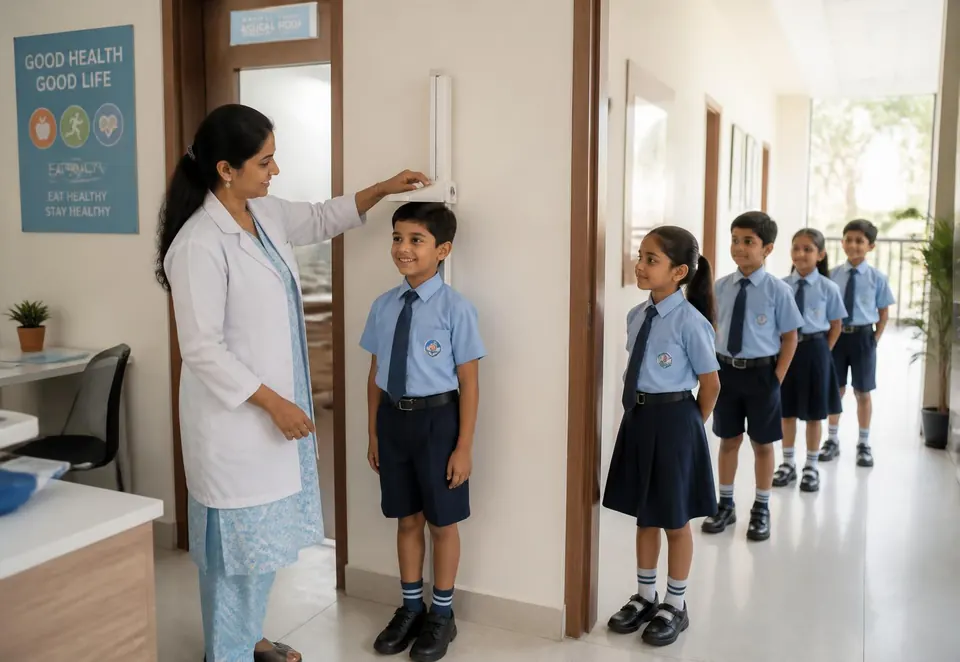
A school health program is a planned set of activities that helps a school notice, record and follow up on students' health and wellbeing. It is more than a one-day medical camp.
A complete programme usually connects an annual student health checkup, first aid and medical-room support, emotional wellbeing support, health education and clear communication with parents.
The aim is practical: find concerns early, refer them to the right professional, and help children stay healthy enough to learn.
Government programmes and private providers are different
India has national school health initiatives, including the School Health and Wellness Programme under Ayushman Bharat, which works through government systems and government schools.
A private provider such as Educure is separate. Schools contract it directly for services they choose. It is not part of, appointed by or affiliated with any government programme.
Many private and aided schools use both ideas: they follow official guidance and add services that fit their own campus, board and families.
The core building blocks
Most schools pick from these components. Not every school needs all of them in the first year.
- Student health checkup: growth and BMI, vision, dental, ENT and general examination, chosen by age group.
- School clinic or infirmary: a nurse-staffed medical room with first aid, visit records and parent contact.
- School counsellor and school psychologist: confidential emotional support and referral pathways.
- Fitness assessment: age-appropriate measures of movement and physical activity.
- Health safety awareness sessions: hygiene, nutrition, first aid, adolescent health and safety topics.
- Digital health records: private reports for parents and aggregate summaries for the school.
Step 1: Decide what problem you are solving
Start with your own situation. A pre-school needs gentle screening and parent follow-up. A boarding school needs infirmary cover and night-time arrangements. A large day school may need counselling more urgently than a new camp.
Write down what happens today when a child feels unwell, who records it and how parents are told. Gaps in that chain are usually the first priority.
Step 2: Plan consent, privacy and communication
Parents should know what will be checked, who will check it and how results are shared before any screening day. Collect consent in writing or digitally, and respect parents who decline.
Individual results go privately to the family. The school receives aggregate summaries, not lists of named children with medical details.
Agree the languages for consent forms, reports and sessions in advance so every family can understand them.
Step 3: Build a simple annual calendar
A calendar keeps the programme from becoming a single event. A simple example (not a fixed delivery promise) looks like this:
- Term start: consent collection, medical forms and care instructions for children with known conditions.
- First term: annual student health checkup by grade, then private parent reports.
- Mid-year: health safety awareness sessions and a review of clinic visit patterns.
- Before exams: counsellor availability and exam-stress sessions.
- Year end: a school-level summary and planning for next year.
Health safety awareness sessions
Awareness sessions turn health information into everyday habits. Good sessions are short, age-appropriate and interactive.
Common topics include handwashing and hygiene, healthy eating, oral health, first aid basics, road and water safety, screen habits, and adolescent health for older students.
Sessions educate. They do not diagnose and they do not replace the clinic, counsellor or a doctor's advice.
Step 4: Choose a provider with clear answers
Ask every shortlisted provider the same questions: who examines students, what is included, how consent works, what reports look like, how follow-up happens and what is excluded from the price.
Compare written proposals with the same scope. A lower quote that leaves out reports or follow-up is not a saving.
What it costs
Cost depends on enrolment, the screening modules chosen, staffing hours for a nurse or counsellor, travel and reporting. We do not publish a single price because two schools rarely need the same scope.
Ask for an itemised proposal so you can add or remove components and see the effect on the total.
Roles and responsibilities inside the school
A programme runs smoothly when everyone knows their part. Write these roles into a one-page plan and share it with staff at the start of the year.
- Principal or management: approves scope, budget and the annual calendar.
- Health coordinator: a named teacher or administrator who liaises with the provider and parents.
- Class teachers: share notices, collect consent and move students on screening days.
- School nurse or clinic staff: daily care, visit records and parent contact.
- Counsellor: confidential wellbeing support and referrals.
- Provider: qualified professionals, equipment, reports and follow-up support as agreed.
How to measure whether the programme is working
Avoid judging the programme by the number of events alone. Look at whether information leads to action.
Useful questions include: Did every consenting student receive a report? How many families acted on a follow-up suggestion? Are clinic visits recorded completely? Do students know how to reach the counsellor?
Review these points at the end of each term and adjust the plan for the next one. Small, steady improvements matter more than a large one-off camp.
Planning by city
Local conditions matter: heat in some regions, long monsoons in others, language preferences and travel times between campuses.
Schools can see local planning notes for Mumbai, Delhi NCR, Bengaluru, Hyderabad, Chennai, Pune, Kolkata, Ahmedabad, Jaipur, Lucknow, Chandigarh, Surat, Indore, Bhopal, Nagpur and Kochi on our city pages.
Frequently asked questions
- Is a school health program compulsory in India?
- Requirements depend on your board, state and school type. Check your board's current circulars. Many schools run a programme because it supports students and parents, not only for compliance.
- How long does it take to start?
- Once scope and consent are agreed, a first checkup can usually be scheduled for a suitable term date. The timeline is confirmed in the written proposal.
- Can we start small?
- Yes. Many schools start with an annual student health checkup and add a clinic, counselling or awareness sessions later.
- Is Educure part of a government school health programme?
- No. Educure is a private provider that schools contract directly.
- Does a school health program need a full-time doctor?
- Not usually. Many schools combine a nurse during school hours with scheduled doctor visits for checkups. The right mix depends on enrolment and whether the school is residential.
- What should we do first if our budget is limited?
- Start by writing down what happens when a child is unwell today, then fix the biggest gap, often consent, records or a basic annual checkup.
Plan school health checkup services for your school
Discuss your school's requirementsExplore our school health checkup services program for schools across India.
See School Health Checkup ServicesPrint the school health checklistRequest a Proposal for Your School
Tell us your school, city and requirement for school health checkup services. Our team will confirm scope, availability and quotation conditions.
More school health articles
Written by Educure School Health, which provides school health services. This is general planning guidance for schools and parents, not medical advice. A qualified clinician should assess any individual health concern.