School Health Checkup Programme in India: A Complete Guide for Schools
How schools in India can plan an annual student health checkup programme — from consent and scheduling to reports, referrals and health cards — in line with NEP 2020.
Educure School Health editorial ·
General educational information, not an individual clinical assessment. No named clinical review is recorded for this article.
Why an annual school health checkup matters
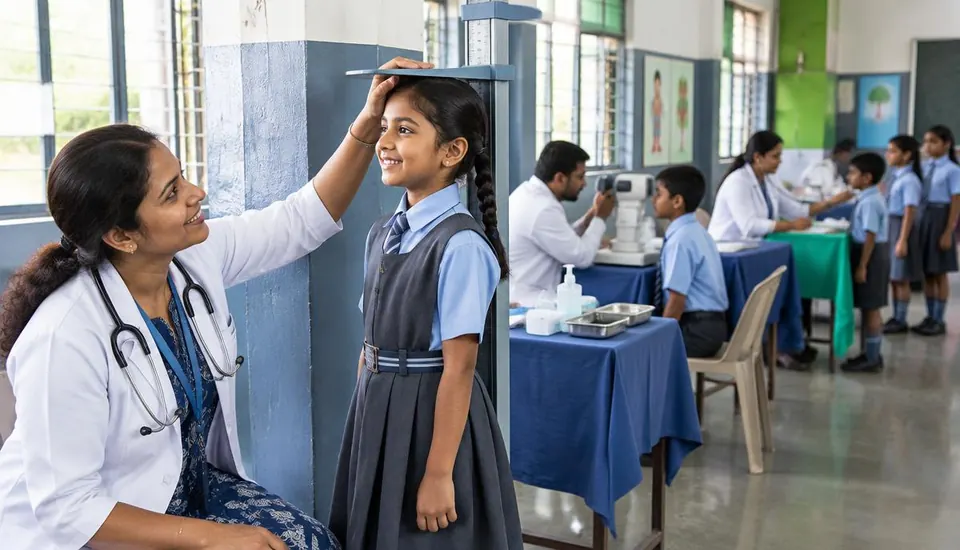
A school sees a child for six or more hours a day, for most of the year. That makes it one of the few places where every child can be checked on a regular schedule, not just the ones whose families already visit a doctor. A well-run school health checkup in India is less about a one-day camp and more about a repeatable process: measure, record, inform parents and follow up.
Many common problems in children give few obvious signs. A child who cannot see the board clearly may simply move to the front row. A child with tooth decay may eat less without saying why. An annual student health checkup gives the school and the family a baseline, so changes from one year to the next are easier to notice.
What NEP 2020 and national programmes say
The National Education Policy 2020 states that children's health, including mental health, will be monitored through regular health check-ups, and that health cards will be issued to students to track this. For schools, the practical meaning is clear: checkups should happen on a schedule, and each child should have a record that can be read over time.
The Government of India also runs the School Health and Wellness Programme under Ayushman Bharat, delivered jointly by the health and education ministries in government schools. It focuses on health promotion through trained teachers acting as health and wellness ambassadors. Private schools are not bound by the same delivery model, but the programme is a useful reference for the kinds of topics a school health programme can cover.
Board affiliation rules, state guidance and a school's own policies may add further requirements. Schools should check the current rules that apply to them directly rather than rely on summaries.
What a school health checkup usually covers
The exact scope should be agreed with the school and the doctors carrying out the checks. A typical annual checkup includes:
- Height, weight and BMI, plotted against age so growth trends are visible.
- Vision screening, to flag children who may need a full eye examination.
- Dental screening, looking for decay, gum problems and hygiene concerns.
- Ear, nose and throat checks, including a basic hearing screen where suitable.
- A general physical examination, covering skin, posture and any visible concerns.
- Review of the child's vaccination record, where parents have shared it.
Planning the checkup step by step
Schools that run smooth checkups usually follow the same basic sequence:
- Agree the scope, dates and class-wise schedule with the health provider, keeping exams and events in mind.
- Send parents a clear consent note explaining what will be checked, who will check it and how results will be shared.
- Prepare a quiet space with good light for vision checks, privacy for examinations and a female staff member present where needed.
- Run the checkups class by class with a teacher coordinating movement so teaching time lost is small.
- Share an individual report with each family and a summary, without names, with school management.
- Follow up on children who need further review, and record whether the family has seen a doctor.
Reports, health cards and follow-up
A checkup is only useful if someone acts on the findings. Each family should receive a report written in plain language, saying what was found and what to do next. Where a child needs further review, the report should say so clearly and suggest the type of doctor to see. The school should not attempt diagnosis or treatment beyond first aid.
Digital health cards make it easier to compare year-on-year results and to share them securely with parents. Whatever format is used, access should be limited to the people who need it, and the school should explain to families how their child's information is stored and protected.
Communicating with parents before and after
Parents are more likely to act on results when they understand the process from the start. A short note a week before the checkup should explain which classes are involved, what each check involves, whether children need to bring anything such as spectacles, and how families can share existing medical information. Offering the note in the languages families use at home helps it reach everyone.
After the checkup, timing matters. Reports that arrive months later are often ignored. Aim to share individual results within a few weeks, flag urgent concerns to parents directly by phone, and remind families about pending referrals before the next term begins. Teachers should also be told, in general terms, about needs that affect classroom life, such as a child who should sit closer to the board.
Measuring whether the programme is working
A school health programme should be judged by follow-through, not only by how many students were checked. Useful questions for school management include: what share of referred children were seen by a doctor, how quickly reports reached families, and whether the same concerns appear in the same classes year after year. These measures help the school decide where to add awareness sessions, adjust canteen food or plan more physical activity.
Keeping these numbers anonymous and reviewing them once a year with the health provider turns a one-day event into a programme that improves over time.
How Educure's programme supports schools
Educure's school health checkup programme covers growth, vision, dental, ENT and general examination, with a digital report for each family and an anonymised summary for the school. Screening teams can check up to 500 students a day, depending on the school's layout and schedule. The checkup can also be combined with counselling, fitness assessment and awareness sessions as part of a wider school health programme.
Pricing, scope, travel and GST are confirmed in each school's written quotation. If your school would like to plan a checkup, you can request a proposal and our team will confirm what is possible for your campus.
Frequently asked questions
- How often should schools run a student health checkup?
- NEP 2020 refers to regular health check-ups, and most schools run one full checkup each academic year, with extra follow-up for children who were referred.
- Do parents need to give consent?
- Yes. Schools should inform parents in advance about what will be checked and how results will be shared, and respect a family's decision to opt out.
- Does a school checkup replace a visit to the doctor?
- No. A school checkup is a screening. Any concern it raises should be reviewed by a qualified doctor.
- Who sees my child's results?
- The individual report goes to the family. School management should only see summaries without names, unless a specific concern needs the school's support.
Sources and further reading
- National Education Policy 2020 — Ministry of Education, Government of India
- School Health and Wellness Programme under Ayushman Bharat — National Health Mission
General information for schools and parents, not medical advice. Consult a qualified professional about an individual child.
Plan school health checkup services for your school
Discuss your school's requirementsExplore our school health checkup services program for schools across India.
See School Health Checkup ServicesPrint the school health checklistRequest a Proposal for Your School
Tell us your school, city and requirement for school health checkup services. Our team will confirm scope, availability and quotation conditions.
More school health articles
This article was written by Educure School Health, which provides school health services. It is general information, not medical advice. Please consult a qualified doctor about any individual child's health.