Pediatric services & immunization
Pediatric Care & Immunization for School Children
Schools are the best place to reach children for preventive health. Together with parents, we support vaccination awareness, regular growth checks and early screening, so small concerns are noticed before they affect learning.
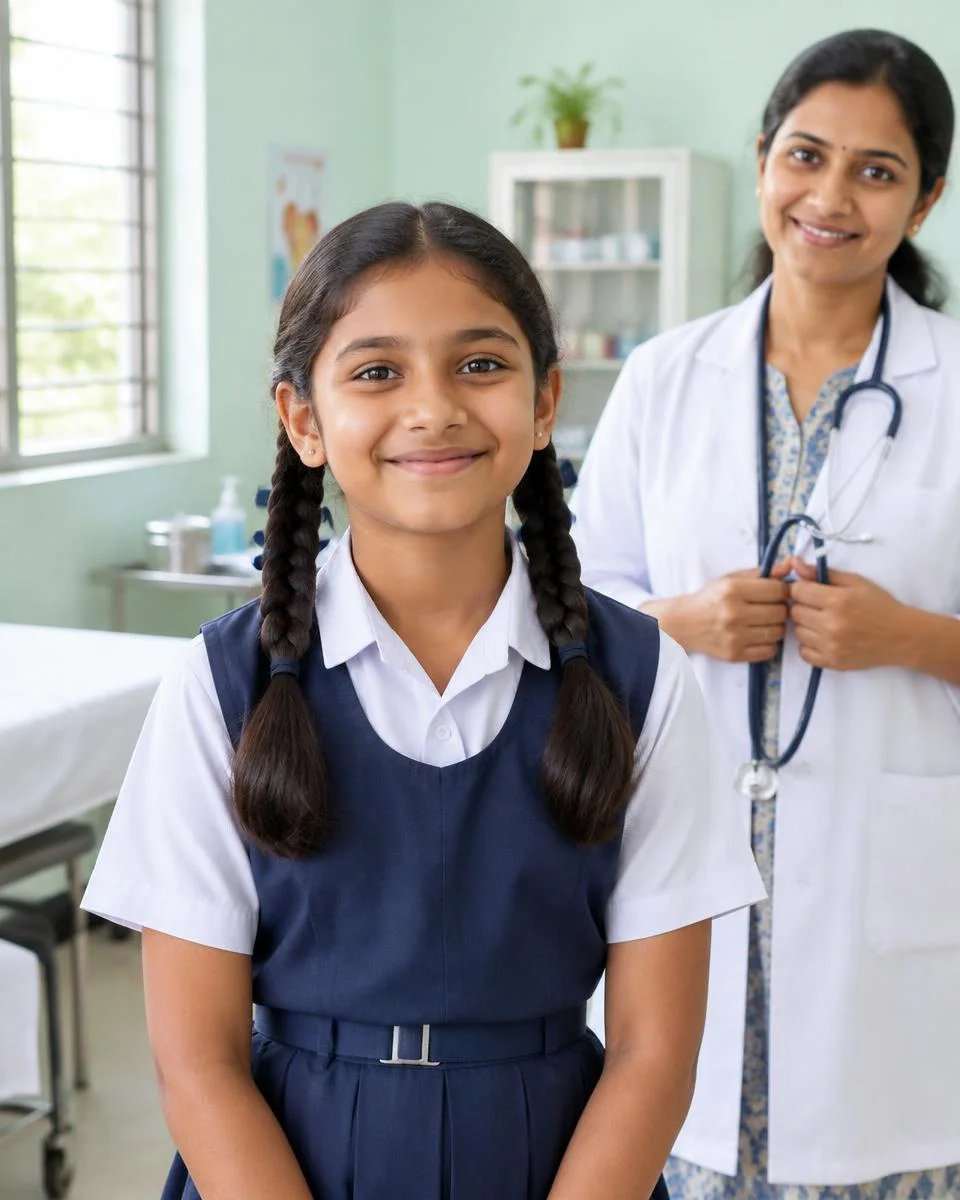
Growth checks, screening & vaccination awareness
Our pediatric services
Care for every stage of growing up
Practical, preventive child health services delivered in school, with results shared clearly with parents.
Routine child health check-ups
Height, weight, BMI and vital signs, plotted on growth charts so you can see how your child is growing year to year.
Vaccination drives & awareness sessions
Simple, age-appropriate sessions for parents and students, and support for schools organising vaccination drives with health authorities.
Developmental & behavioural screening
Early screening for learning, attention, speech and behaviour concerns, with referral when a child needs more support.
Vision & dental screening
Quick checks for eyesight problems and tooth decay, two of the most common issues that affect learning and comfort.
Nutrition counselling & anaemia screening
Guidance on everyday food habits, plus screening for signs of anaemia so families can follow up early.
Teleconsultation with paediatricians
Talk to a doctor from home when a question about your child's health needs more than a search.
Digital health passport & vaccination tracker
One private record for school screening reports, with a free tool to note doses and see which vaccines may be due.
Immunization
Vaccines: what every parent should know
India's Universal Immunisation Programme (UIP) provides free vaccines against 12 vaccine-preventable diseases through government health facilities.
Full immunisation coverage in India is about 98%, according to a Government of India fact sheet (PIB, 17 March 2026).
Vaccines are not legally mandatory in India, but they are strongly recommended.
Government schedule (UIP)
| Age | Vaccines |
|---|---|
| At birth |
|
| 6 weeks |
|
| 10 weeks |
|
| 14 weeks |
|
| 6 months | No routine government dose. Under IAP advice, the yearly influenza vaccine and the typhoid conjugate vaccine can start from 6 months. |
| 9–12 months |
|
| 16–24 months |
|
| 5–6 years |
|
| 10 and 16 years |
|
Schedule per the National Immunisation Schedule. Please confirm exact ages and doses with your doctor or local health centre.
Additional vaccines recommended by the IAP
The Indian Academy of Pediatrics (IAP) recommends these vaccines, which are often given privately. Ages and doses can change, so please confirm with your doctor or local health centre.
Hepatitis A
Protects against a liver infection spread through food and water.
Typhoid conjugate vaccine
Can be given from 6 months of age.
Varicella (chickenpox)
Usually given as two doses in early childhood.
MMR
Adds protection against mumps to measles and rubella.
Influenza
Once every year from 6 months of age.
HPV
From age 9: 2 doses for ages 9–14, 3 doses for ages 15 and above.
In early 2026 the government started a free HPV vaccination campaign for 14-year-old girls at government health facilities. Check current eligibility with your local health centre. Read the announcement
Missed a dose?
Do not restart the series. Continue from where it stopped and ask your doctor for a catch-up plan.
Myths vs facts
Clearing up common worries
Myth: Vaccines cause autism.
Fact: Large studies involving millions of children have found no link between vaccines and autism.
Myth: A fever after a vaccine means something went wrong.
Fact: A mild fever, soreness or fussiness for a day or two is a normal sign the body is building protection.
Myth: Combination vaccines overload a child's immune system.
Fact: Combination vaccines are tested together and mean fewer needle pricks for your child.
Myth: A child with a cold must always skip the vaccine.
Fact: Children with a minor illness, such as a mild cold, can usually still be vaccinated. Your doctor will decide.
For schools
Book a vaccination awareness session for your school
Share a few details and our team will get in touch to plan an age-appropriate session for parents and students.
Frequently asked questions
Sources
Information is for general awareness. Please consult a paediatrician for individual advice.