Why Schools Should Conduct Annual Student Health Checkups
The case for making a yearly student health checkup a routine part of school life, not a one-off event.
By Educure School Health ·
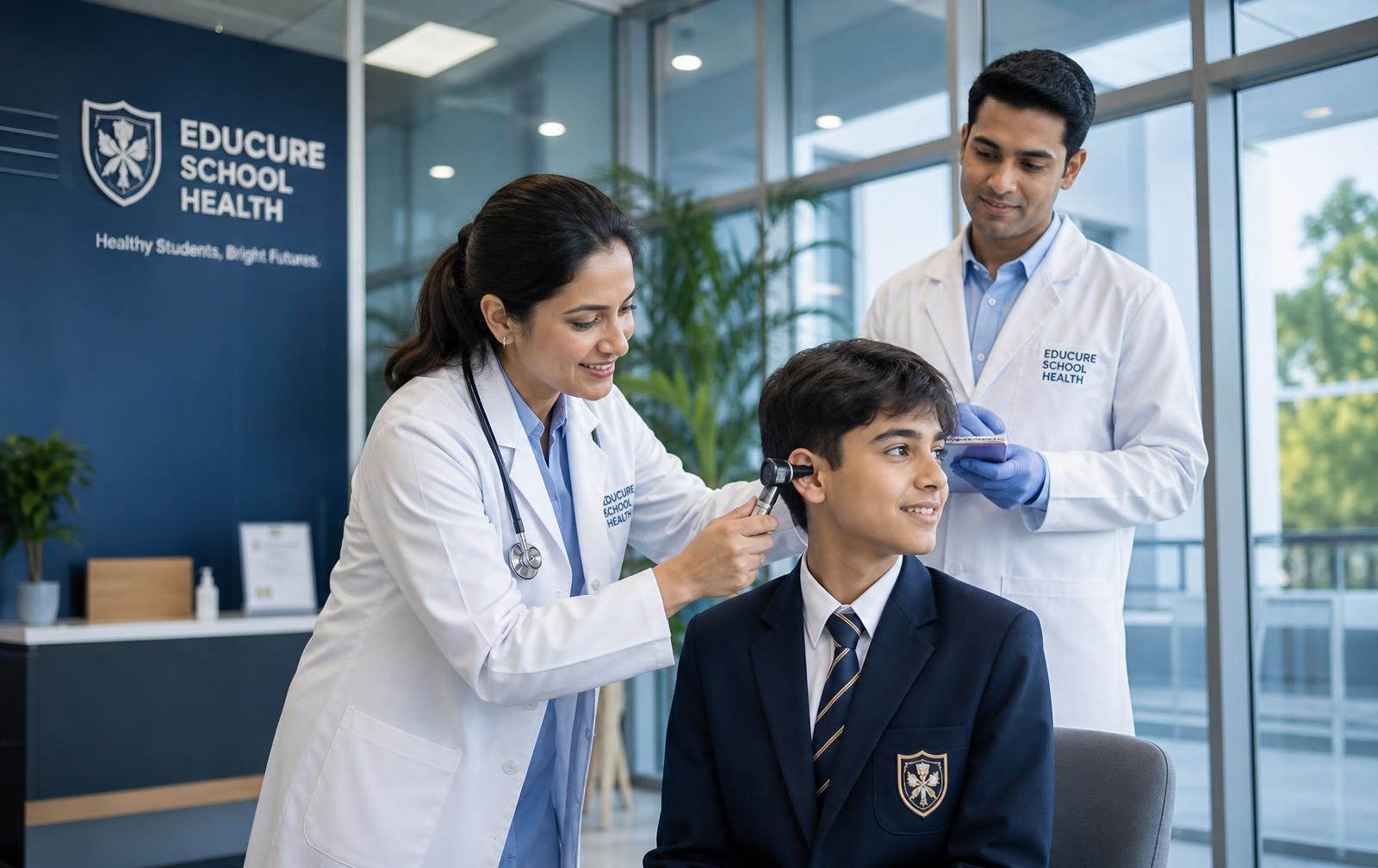
Health issues in children are often invisible
Many of the health issues that affect school-age children do not announce themselves. A child who has been struggling to read the board for months may simply have adapted by sitting closer or copying from a neighbour, never mentioning the strain. A persistent toothache can be dismissed as fussiness, and slow or uneven growth is easy to miss unless it is measured and tracked over time.
Because children are not always able to describe what is wrong, or may not realise something is wrong at all, an annual checkup gives every student a structured opportunity to be looked at by a professional, regardless of whether a parent or teacher has already raised a concern.
Early detection changes outcomes
The value of catching an issue early is well established. The WHO has consistently highlighted that school health screening programs, when linked to proper referral, help children access care sooner, before small problems compound into larger ones that are harder and more expensive to treat. A vision problem caught in Grade 3 is a pair of glasses; left unaddressed for years, it can mean a child who has quietly fallen behind academically.
India's own Rashtriya Bal Swasthya Karyakram (RBSK) was built on this same principle for government schools — systematic screening followed by referral for children who need it. The logic holds just as well in private and CBSE-affiliated schools: a yearly checkup is the mechanism that turns a vague sense that something might be wrong into a concrete, actionable finding.
Meeting CBSE's affiliation requirements
For CBSE-affiliated schools, there is also a clear regulatory dimension. Clause 14.6 of the CBSE Affiliation Bye-Laws requires schools to arrange a medical checkup for students at least once a year and to maintain records of it. An annual checkup, properly documented, is the most straightforward way to demonstrate this during affiliation renewal or inspection.
Schools that treat this as a one-off, poorly recorded event often struggle to produce clean evidence when it is needed. Making the checkup a predictable, calendar-fixed annual event — with consistent records each year — removes this uncertainty entirely.
Building trust with parents
Beyond compliance, an annual checkup is one of the more tangible ways a school demonstrates that it cares about the whole child, not only academic performance. Parents who receive a clear, timely report about their child's health — even when the finding is simply that nothing of concern was noted — tend to view the school as more attentive and trustworthy.
Over several years, this builds a running health record for each child that families genuinely value, since it gives them a reference point they would otherwise have to assemble themselves from scattered doctor visits.
Making it a routine, not a one-off
The schools that benefit most from health checkups are the ones that treat them as a fixed annual fixture — same term, same process, same quality of reporting — rather than something organised reactively when a concern arises or an inspection is due. Consistency is what turns screening data into a useful multi-year record.
Educure helps schools run exactly this kind of consistent, well-documented annual program, with qualified screening teams and digital parent reports delivered promptly. Visit Educure's School Health Checkup page to request a proposal and build a dependable annual routine for your school.
Bring this program to your school
Explore our school health checkup services program for schools across India.
See School Health Checkup ServicesRequest a Proposal for Your School
Tell us your school, city and requirement. Our team will respond within 24 hours.