Vision Screening for School Students
Why vision screening deserves a dedicated place in every school health program, and what principals and parents should expect from it.
By Educure School Health ·
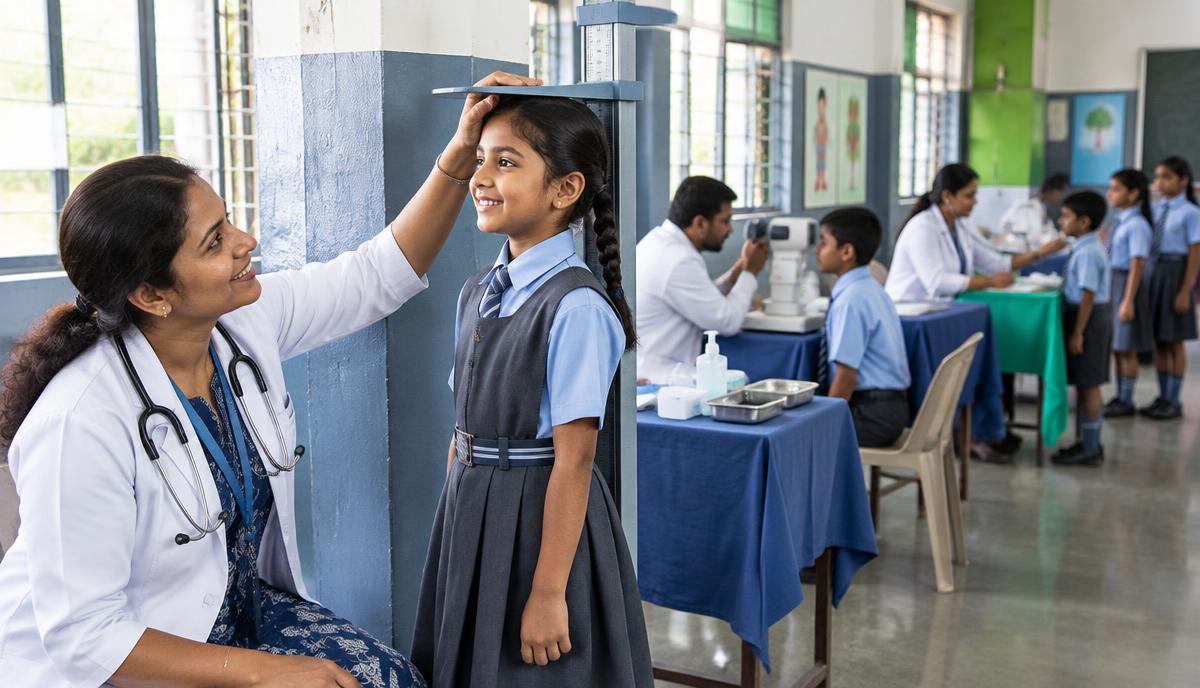
Why vision deserves its own screening station
Vision problems are among the most common, and most fixable, health issues found during school screenings. A child with mild to moderate refractive error — needing glasses for distance or near work — can look and behave entirely normally, which is precisely why this kind of problem is easy to overlook without a dedicated check.
Because so much of classroom learning depends on being able to see the board clearly, read textbooks comfortably and follow visual instructions, uncorrected vision issues can quietly affect a child's grades, confidence and even classroom behaviour, as a child who can't see well may become distracted or disengaged rather than openly complain.
What a school vision screening typically involves
A standard school vision screening uses an eye chart appropriate to the child's age and reading ability, checking each eye separately at a set distance. The screener also looks for visible signs of eye strain, excessive blinking, squinting, redness or watering, and asks a few simple questions about whether the child has noticed any difficulty seeing the board or reading.
This is a screening test, not a full eye examination. It is designed to flag students whose vision may need a closer look, not to determine a prescription or diagnose a specific eye condition. Any such determination requires an examination by a qualified optometrist or ophthalmologist.
What happens when a concern is flagged
When a student does not pass the basic vision screening, the standard next step is a referral note to the parents recommending a full eye examination. The school's role ends at flagging the concern clearly and promptly; it is then up to the family to take the child for the recommended follow-up visit.
Schools can meaningfully improve outcomes here simply by making the referral easy to act on — a clear report, a plain explanation of what was observed, and perhaps a gentle follow-up reminder a few weeks later for parents who haven't yet responded, since follow-through is often the weakest link in the chain.
The classroom benefits of good vision
Once a vision issue is corrected, teachers often notice a genuine improvement in a child's attentiveness and participation, since so many visual cues in a classroom — board writing, worksheets, visual aids — depend on clear sight. This is one of the more direct, demonstrable links between a school health initiative and classroom outcomes.
It also reinforces why vision screening is worth doing consistently every year rather than occasionally: a child's eyesight can change from one year to the next, especially during the growth years, so a single screening early in school life is not enough to catch problems that develop later.
Building vision screening into your school's program
A well-run vision station, as part of a broader annual checkup, ensures no student's eyesight goes unchecked for a year at a time, and gives parents a clear, actionable report rather than a vague note. This is most reliable when handled by a team experienced in running screening at scale across a full student body.
Educure's School Health Checkup program includes vision screening as a standard component, with individual parent reports and school-level summaries. To add or strengthen vision screening at your school, visit Educure's School Health Checkup page and request a proposal.
Bring this program to your school
Explore our school health checkup services program for schools across India.
See School Health Checkup ServicesRequest a Proposal for Your School
Tell us your school, city and requirement. Our team will respond within 24 hours.