Why HPV Awareness Matters for Schools
India carries roughly a fifth of the world's cervical cancer burden — a cancer that is largely preventable. Here is how Educure delivered an HPV awareness initiative for Merck across 500+ schools Pan India.
By Educure School Health ·
A preventable cancer that still kills Indian women
Cervical cancer is among the most common cancers in Indian women, and India accounts for a large share of global cases and deaths. Almost all of it is caused by persistent infection with high-risk human papillomavirus — which means it is one of the very few cancers that can be prevented rather than only treated.
The prevention pathway is well established: HPV vaccination in the adolescent years, before exposure, plus screening for adult women later in life. The gap in India is not medicine. It is awareness, hesitancy and the absence of a trusted place to ask questions.
Schools are that trusted place. They already reach adolescents, their mothers and a largely female teaching workforce — exactly the three audiences an HPV conversation needs.
The initiative
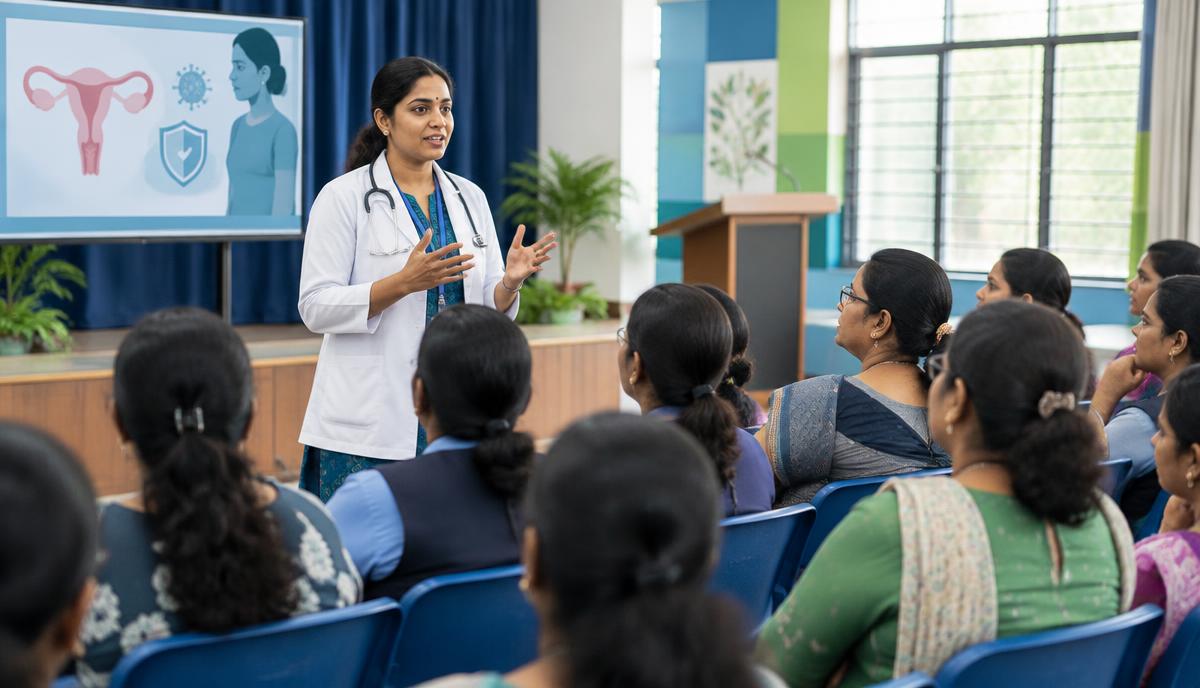
Educure designed and managed an HPV and cervical cancer awareness initiative on behalf of Merck, delivered across more than 500 schools Pan India and reaching over 42,000 parents and school staff.
The format was deliberately simple and repeatable: a school-hosted session for mothers and women staff, led by a qualified doctor, in the local language, with a question-and-answer segment that ran longer than the presentation itself in almost every venue.
What each session covered
What HPV is and how common it is. The link between persistent high-risk HPV infection and cervical cancer, explained without alarm. Why the vaccine works best when given in the adolescent window, and what the national recommendation is.
Screening for adult women — what a Pap smear and HPV DNA test are, when to start, and how often. Early warning symptoms that should never be ignored.
Directly addressing hesitancy: safety of the vaccine, the myth that it encourages early sexual activity, cost and availability, and where to go locally. Sessions closed with printed take-home material in the regional language and a route to speak to a doctor privately.
What we learned running it at scale
The school is the credibility. A message delivered through the child's school lands very differently from an advertisement — attendance and question quality were consistently higher where the principal introduced the session personally.
Women staff are an underserved audience. Teachers, administrative staff and support staff frequently had no prior screening and asked the most detailed questions. Including them was not a courtesy; it was one of the highest-value parts of the programme.
Language and privacy matter more than slides. Regional-language delivery and a private follow-up channel converted far more interest into action than the session content alone.
Measure reach, not just events. Attendance capture, session feedback and follow-up tracking are what turn an awareness drive into reportable impact for a pharma partner's public-health objectives.
Partner with us for a school awareness programme
Educure runs vaccination, nutrition and oral-care awareness programmes for pharma and consumer-health partners across a Pan-India network of 1000+ connected schools. We handle school onboarding, consent, doctor panels, regional-language content, session delivery, attendance capture and impact reporting.
These programmes are educational and awareness-led. They inform parents and staff and direct them to qualified doctors for decisions; they are never a substitute for medical advice.
If you are a pharma, CSR or public-health partner and want a measurable school-based awareness footprint, speak to our partnerships team.
Bring this program to your school
Explore our health awareness sessions for schools program for schools across India.
See Health Awareness Sessions for SchoolsRequest a Proposal for Your School
Tell us your school, city and requirement. Our team will respond within 24 hours.